
Blood Cancer and Precision Medicine: A New Era for CML
Dr Bianca Ogden
Portfolio Manager, Platinum International Health Sciences Fund
Some 25 years ago, imatinib (brand name Glivec/Gleevec), a tyrosine kinase inhibitor (TKI), revolutionised the treatment of chronic myeloid leukaemia (CML). What was once a deadly blood cancer is today considered a chronic disease.¹ The development and approval of imatinib marked a milestone for precision medicine. At the time, primary care and cardiovascular diseases dominated drug development, while targeted cancer therapies were viewed as outliers and “not profitable enough”.
Fast forward to today, and the oncology landscape has changed dramatically. CML is now regarded as a poster child for precision medicine, thanks to a cytogenetic abnormality² — the Philadelphia chromosome, first identified in 1950 — that drives the uncontrolled growth of immature white blood cells. The Philadelphia chromosome forms when pieces of chromosome 9 and chromosome 22 swap places (see illustration below).
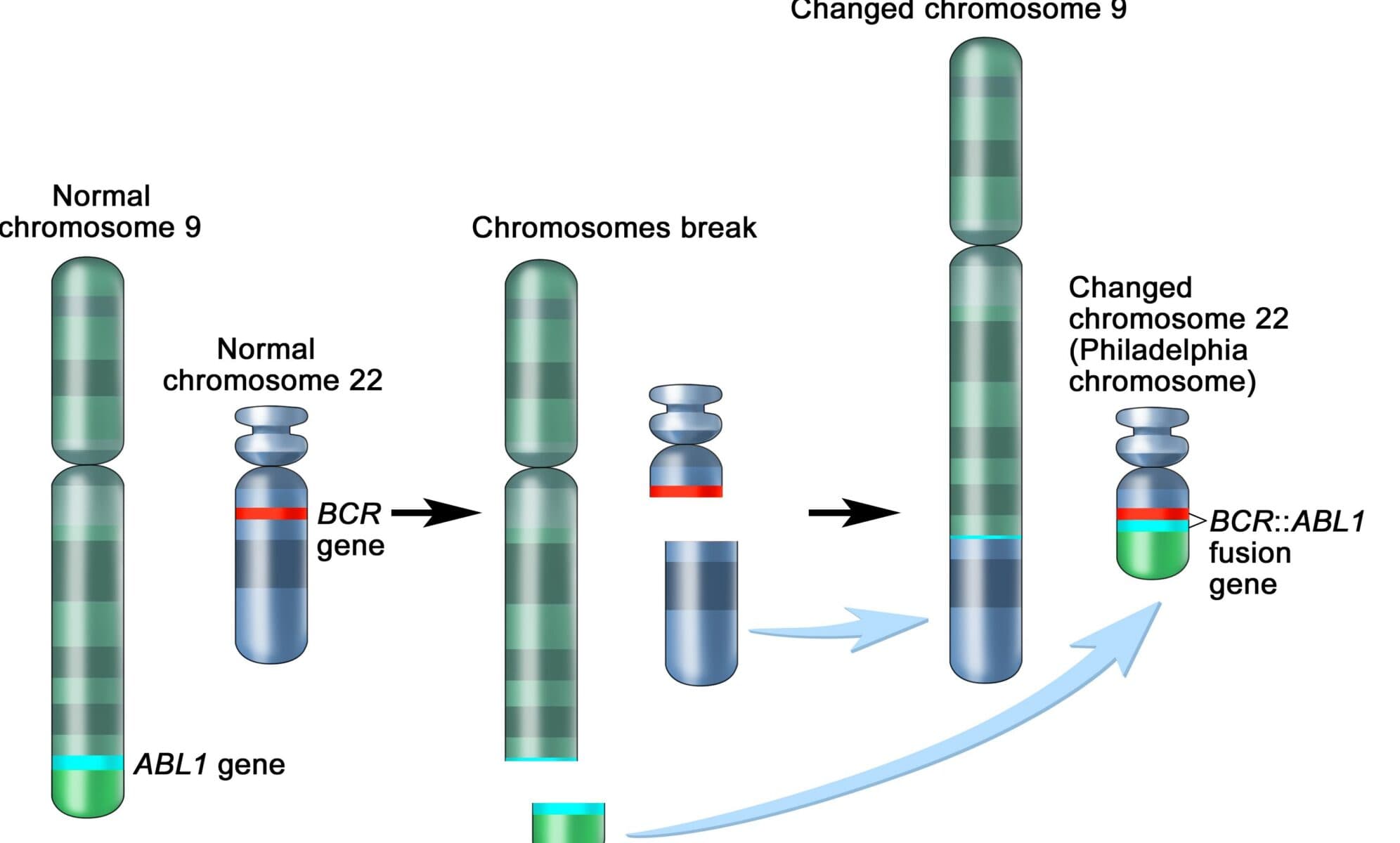
In the 1980s, scientists further characterised this translocation, demonstrating that the ABL proto-oncogene (ABL1, a protein tyrosine kinase*) forms a fusion protein with the BCR gene^. This fusion protein creates a permanently active enzyme, resulting in uncontrolled cell growth and ultimately causing CML.
Kinases are enzymes that catalyse the transfer of phosphate groups from ATPδ to proteins, thereby mediating cell signalling. Kinases have been important drug targets for decades, most commonly through compounds that directly target the active site responsible for ATP transfer.
In the 1990s, scientists at Ciba-Geigy (now Novartis) developed an active-site kinase inhibitor that shut down the activity of the BCR-ABL fusion protein described above. I was fortunate to be working in the laboratory next door at Ciba at the time.
Following the approval of imatinib, additional active-site kinase inhibitors targeting kinase mutations were approved. However, the challenge with active-site inhibitors is the eventual emergence of resistance, as well as side effects and intolerance. This dynamic has continued to play out in CML, highlighting the need for next-generation therapies with differentiated mechanisms of action.
This is where allosteric inhibitors may make a significant difference. The term “allosteric” comes from the Greek allos, meaning “other” or “different”, and stereos, meaning “space”. Proteins — including enzymes — are dynamic molecules that change shape, and therefore function, shifting for example between active and inactive states.
Over the past decade, advances in computational science, machine learning and biophysical tools have enabled scientists to better understand these conformational “shift changes” and map allosteric sites that influence protein structure and interaction. These sites are often hidden, yet they play a critical functional role and therefore represent attractive therapeutic targets.
The ABL kinase contains one such allosteric site. Under normal circumstances, the kinase self-regulates through modification of this site via a fatty acid attachment. Specifically, a myristoyl group (a 14-carbon fatty acid) binds to the “myristoyl binding pocket”, changing the shape of the kinase and switching it into an inactive state.
The BCR-ABL fusion protein, however, loses this myristoylation capability, leaving the active site effectively “always open for business”. As a result, the myristoyl binding pocket represents a highly attractive drug target.
In 2021, Novartis received approval for asciminib, an allosteric inhibitor that mimics myristoylation. Commercially, the drug has been successful, validating the need for new mechanisms of action for CML patients. However, asciminib requires fasting for several hours prior to dosing, which is inconvenient for patients. In addition, around one-third of first-line patients fail to achieve a deep response.
Terns Pharma has also been developing a more selective allosteric inhibitor targeting the myristoyl binding pocket. We invested in Terns in early 2025, attracted by its compelling valuation and the emerging profile of TERN-701, including its high selectivity for the target site and deepening responses in treatment-failure patients.
This quarter, clinical data showed that the drug is highly effective in patients previously treated with the Novartis allosteric inhibitor, as well as in patients who had received other experimental therapies. Importantly, there was no requirement for fasting and no observed signs of hypertension or pancreatitis. Although based on a relatively small patient cohort, these are outstanding data.
We also know there is historically strong read-through from early-stage efficacy data to approval and use in earlier lines of treatment. In our view, this drug has a credible opportunity to establish a new standard of care in the treatment of CML.
It is particularly gratifying to witness this progress, given that Glivec first sparked my passion for drug development when I met the scientists behind the medicine while working at Ciba-Geigy.
Explore the future of healthcare innovation
Learn how the Platinum International Health Sciences Fund invests in global leaders across biotechnology, pharmaceuticals and medical technology.
* ABL1 also known as Abelson murine leukemia viral oncogene homolog 1.
^ Breakpoint cluster Region gene.
δ ATP: Adenosine triphosphate, the main energy carrier in a cell.
The above information is commentary only (i.e. our general thoughts). It is not intended to be, nor should it be construed as, investment advice. To the extent permitted by law, no liability is accepted for any loss or damage as a result of any reliance on this information. Before making any investment decision you need to consider (with your financial adviser) your particular investment needs, objectives and circumstances.
Related Journals
View all related reads
Reaching its Apogee? Inside One of Biotech’s Most Interesting Emerging Stories
An inside look at the investment case behind Apogee Therapeutics, from preclinical promise through to emerging clinical validation.

Europe’s Rise in Biotech Innovation
Chinese biotech may dominate headlines, but European companies like Genmab and Merus are emerging as important innovators in antibody therapies.