
Too much certainty?
David Steinthal
Chief Investment Officer, L1 Capital International | Portfolio Manager, Platinum International Fund and Platinum Global Fund (Long Only)
“Doubt is an uncomfortable condition, but certainty is a ridiculous one.”
Attributed to Voltaire.
Voltaire’s quote encapsulates our perspective on the current investment environment. Many commentators express their views on unknowable issues such as the path of geopolitics or Artificial Intelligence (AI) with certainty. We consider that ridiculous.
Share prices can also reflect too much certainty, characterising businesses in white or black as ‘AI Winners’ or ‘AI Losers’. As discussed in our March Quarterly Report,¹ we see ‘grey’ – a distribution of probabilities.
Uncertainty is uncomfortable, but it can create attractive risk-adjusted investment opportunities. While the share prices of some companies in our portfolio have partially recovered during the quarter, we continue to see compelling value in high-quality businesses for investors with a longer-term horizon.
Macroeconomic environment
Despite another quarter dominated by geopolitics, there was limited change in the underlying macroeconomic backdrop.
Macroeconomic environment
Despite another quarter dominated by geopolitics, there was limited change in the underlying macroeconomic backdrop.
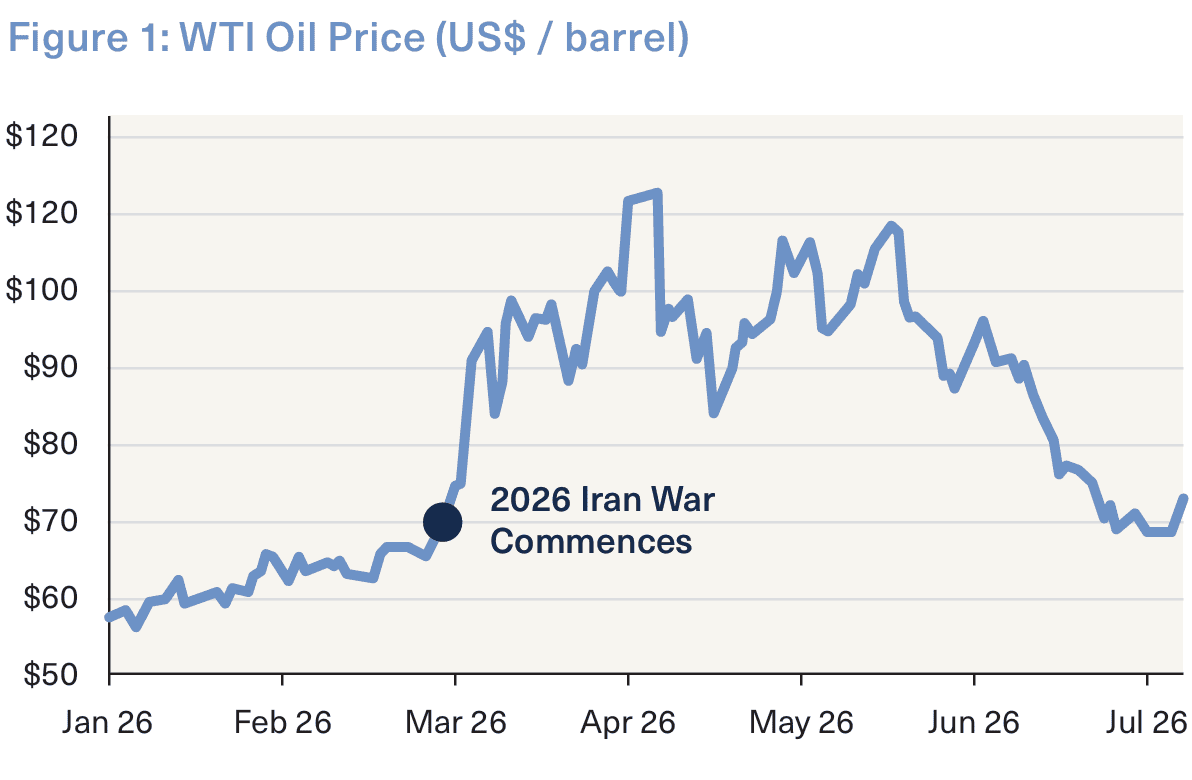
The Middle East conflict initially de-escalated, with trade through the Strait of Hormuz resuming. After quarter end, the conflict flared up again, providing another reminder of geopolitical uncertainties. Fears of a major oil shortage were quickly replaced with concerns about an oil glut.
The spot oil price rapidly fell to levels only modestly above pre-conflict prices, although there has been a recent uptick following the resumption of military action.
Investors continue to look through the conflict, expecting supply chain disruptions and associated inflationary pressures to be modest and temporary. The longer the conflict continues, the greater the downside risks.
The first Federal Open Market Committee (FOMC) meeting chaired by Kevin Warsh came and went, with no change to the Federal Funds Rate. The official FOMC statement was brief, though Chairman Warsh’s subsequent press conference was more ‘hawkish’ (potentially increasing interest rates to reduce inflation) than many observers expected.
Global macroeconomic data remains mixed. Recognising that the future is a distribution of probabilities, our base case remains unchanged:
- A two-speed economy. Affluent consumers continue to thrive while lower socio-economic consumers are challenged by cost-of-living pressures.
- AI-related investment remains exceptionally strong while many traditional sectors remain subdued.
- Labour markets remain resilient, although AI introduces longer-term uncertainty.
Equity market conditions
Equity markets continue to be dominated by the ‘AI winners’ / ‘AI losers’ trade and associated momentum. Memory has become the latest AI capital expenditure bottleneck. There has been a genuine step change in demand, not speculation. Tight oligopolistic supply has caused a parabolic increase in the price of memory components and the share price of memory manufacturers.
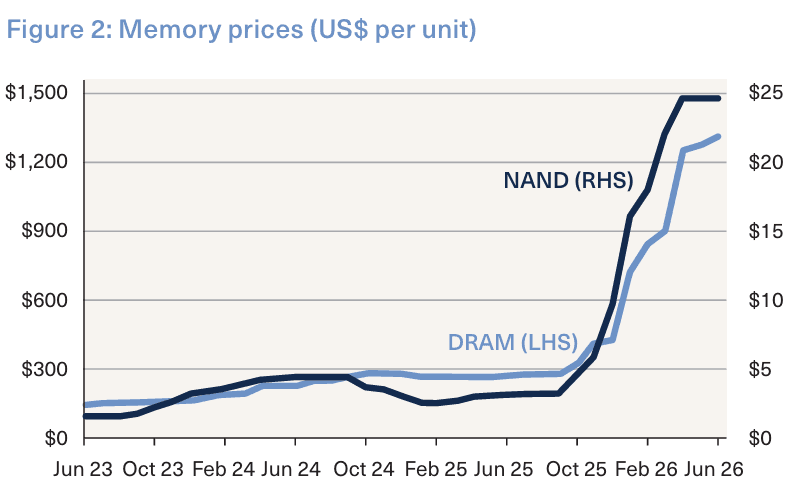
The stock market in the past quarter, and much of the past 12 months, has been dominated by AI capital expenditure winners and momentum, to the exclusion of almost everything else.
If you thought markets, particularly the US, were now dominated by a small number of largely technology companies, they are. We are back to US market concentration last seen in the 1960s. This creates attractive investment opportunities outside the current market darlings.
And if you thought individual company share prices were moving with abnormal volatility, they are. Single-stock volatility reflects increasingly polarised investor positioning.
What does this mean for investors?
We continue to see a future of uncertainty, with a range of potential outcomes of varying probabilities. No area better illustrates the range of potential outcomes than AI. Expressing certainty on its long-term impact is a mistake. So too is ignoring its investment opportunities.
The current enthusiasm for AI has limited parallels with the dot.com era. AI is not a fad, infrastructure bottlenecks such as memory are real, and we expect strong growth in AI capital expenditure well into the future. Many AI beneficiaries are amongst the largest, most profitable and financially strongest businesses in the world.
At the same time, valuations of some ‘AI Winners’ increasingly assume sustained exceptional growth and near-perfect execution. However, not every AI-related share price is so frothy and we continue to see pockets of compelling value among AI beneficiaries.
In our Platinum International Fund report (page 6), we outline how the portfolio has been selectively tilted to benefit from sustained growth in AI capital expenditure and away from potential AI losers.
We also continue to see attractive valuations for many high-quality businesses that are not particularly AI sensitive and have increased exposure to several businesses in this category.
Explore the Platinum International Strategy
Discover how the Strategy identifies high-quality businesses and long-term investment opportunities across global markets, even in periods of heightened uncertainty.
Share this
- Platinum Quarterly Report March 2026, https://l1.group/4yqyO1F
The above information is commentary only (i.e. our general thoughts). It is not intended to be, nor should it be construed as, investment advice. To the extent permitted by law, no liability is accepted for any loss or damage as a result of any reliance on this information. Before making any investment decision you need to consider (with your financial adviser) your particular investment needs, objectives and circumstances.
Related Journals
View all related reads
The Next Asian Winners May Not Be AI with Cameron Robertson | Equity Mates
From AI infrastructure to healthcare and consumer businesses, explore the opportunities shaping Asia’s diverse markets. Scroll down to watch the interview.

September 2026 Investor Update | Platinum International Fund
David Steinthal, Portfolio Manager of the Platinum International Fund, discusses the current investment environment, the ongoing impact of artificial intelligence on markets and company fundamentals, and why Platinum continues to see compelling long-term opportunities across much of the portfolio.
Platinum Asia Fund | Investor Update
Watch Cameron Robertson, Portfolio Manager of the Platinum Asia Strategy, discuss the forces shaping Asian markets, emerging growth opportunities and long-term themes for the Platinum Asia Fund. Released 1 September 2026.