
Livewire | Up 570% and he’s still selling: the discipline behind this fund manager’s call
Cameron Robertson
Portfolio Manager, Platinum Asia Strategy
This article was first published by Stephanie Gardner in Livewire Markets on 24 March, 2025.
According to Cameron Robertson, the best opportunities right now sit at the intersection of structural growth and temporary mispricing, and the biggest risk is assuming today’s obvious winners will stay that way.
And it’s all happening at once. Humanoid robots are breaking world records. Driverless taxis are going fully commercial. Data centres are ordering enough power infrastructure to light up cities.
The breakthroughs are real, but so is the speculation, and markets are rewarding narratives just as aggressively as fundamentals. That blurs the line between genuine long-term winners and stocks priced for perfection.
Robertson is the Portfolio Manager for Asia strategies at Platinum Asset Management, and has spent over 15 years at the firm cutting through exactly that kind of noise – across technology, industrials, and resources.
In this week’s Q&A, he names his most recent buy and exactly why he pulled the trigger, reveals the stock he’s been trimming despite a 570% run and a fantastic outlook, shares what’s just landed on his watchlist, and explains why he’s holding firm on one beaten-down position the market has given up on.
What’s your most recent investment and why?
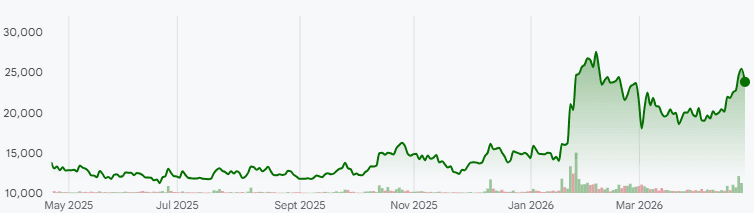
One of our recent investments is the Korean company Lake Materials (KOSDAQ: 281740). It’s a fairly unique company that specialises in the manufacture of high-purity organometallic compounds. In layman’s terms, this is “extreme chemistry”, making incredibly sensitive and dangerous products that explode or rapidly degrade if they come into contact with air or water.
And from a business perspective, that means Lake is one of only a handful of companies globally with the capability to (safely!) mass manufacture certain critical inputs to the global semiconductor, petrochemical, solar, and LED markets.
Extreme demands, in terms of safety and purity, create the conditions for limited competition and strong profits for the companies that are able to meet these needs – like Lake Materials.
That explains why the business has been profitable, but their ability to keep applying this skill set to new and growing markets is really the key to the investment case. The company has spent the past few years building new capacity and incurring costs to get qualified for a range of new products and customers, meaning the next few years should be a period of harvesting the fruits of that labour.
We believe they are going to ride a wave of new, improved, high-quality plastics used in cars, medical applications, and packaging, and will also benefit from having carved out a strong early position in the emerging solid-state battery industry. On a longer-term view, they should continue to see success from changing semiconductor designs that we’re seeing on the horizon, which could drive an explosion of growth in their atomic layer deposition materials business.
Which investment did you add to your watchlist this week?
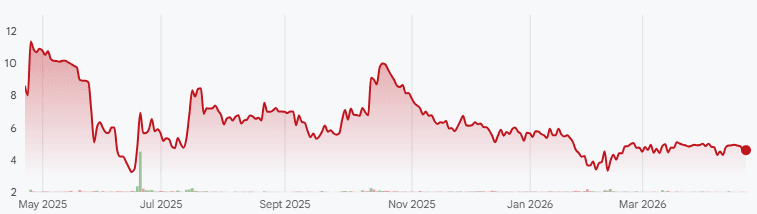
I’ve recently added the Indian company SS Innovations International (NASDAQ: SSII) to my watchlist. Robotic surgery is still in its early stages around the world, and as of today the American company Intuitive Surgical (NASDAQ: ISRG) dominates the space globally, but they’re a high cost, less modular system, and for most of the rest of the world they’d love the benefits that come from the precision of robotic surgery – in terms of reduced complications, faster recovery times, and so on – but can’t afford the cost.
So we’re watching companies around the region with interesting technology in this space to get a sense for how this market will evolve.
And the Indian company SSI has a strong early position in their local market, with good adoption by doctors and medical systems, so it’s definitely one to watch.
We’re still very much in the observing and learning phase on this one, though. Plenty of questions remain.
What is the most recent investment you have trimmed or sold and what drove this decision?
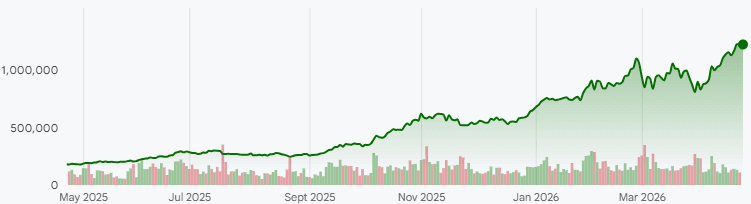
We’ve been trimming our position in SK Hynix (KRX: 000660). We’ve held the stock since 2020. It’s a well-run technology leader in a nice oligopoly market.
Over the past couple of years, they’ve been at the forefront of the wave in meeting AI compute demand. This year, some sell-side analysts believe the company will make over KRW220tr EBITDA, up from ~KRW6tr back in 2023.
Because of this, the shares are up 570% over the past 12 months as we speak.
So the business is booming, the outlook is fantastic, and the valuation remains very reasonable on many measures.
But it’s precisely because right now no one can imagine the world ever looking any different, that it’s important to remain level-headed and remember it is still a somewhat commoditised cyclical industry, with technical hurdles and challenges that need to be grappled with every few years, and as a result, we’ve been pocketing some of our gains as the stock races ahead.
What’s your favourite chart or data point from this week?
There are so many interesting things going on in markets, so if you’ll humour me with a couple, I think they paint a vivid picture. Finnish engine company Wärtsilä (HEL: WRT1V), best known for their marine engines, last week received an order for engines capable of producing 412 MW (enough electricity to power ~300,000 houses), to power a data centre project in the US, highlighting the booming demand for data centres and the contortions the industry is going through to bring on sufficient power infrastructure to support this compute.
Then this week, Beijing hosted a half-marathon for humanoid robots. The winning team came in at 50 minutes 26 seconds, beating out the human world record (57 minutes), but to my mind, the far more impressive stat was the improvement on last year’s winning time of 2 hours 40 minutes, highlighting the dramatic pace of industry innovation & development.
Then, a company in our portfolio, Pony AI (NASDAQ: PONY), began fully driverless operations in the Dubai robotaxi market and – having now proved technical and commercial viability – the technology continues its rapid global roll-out.
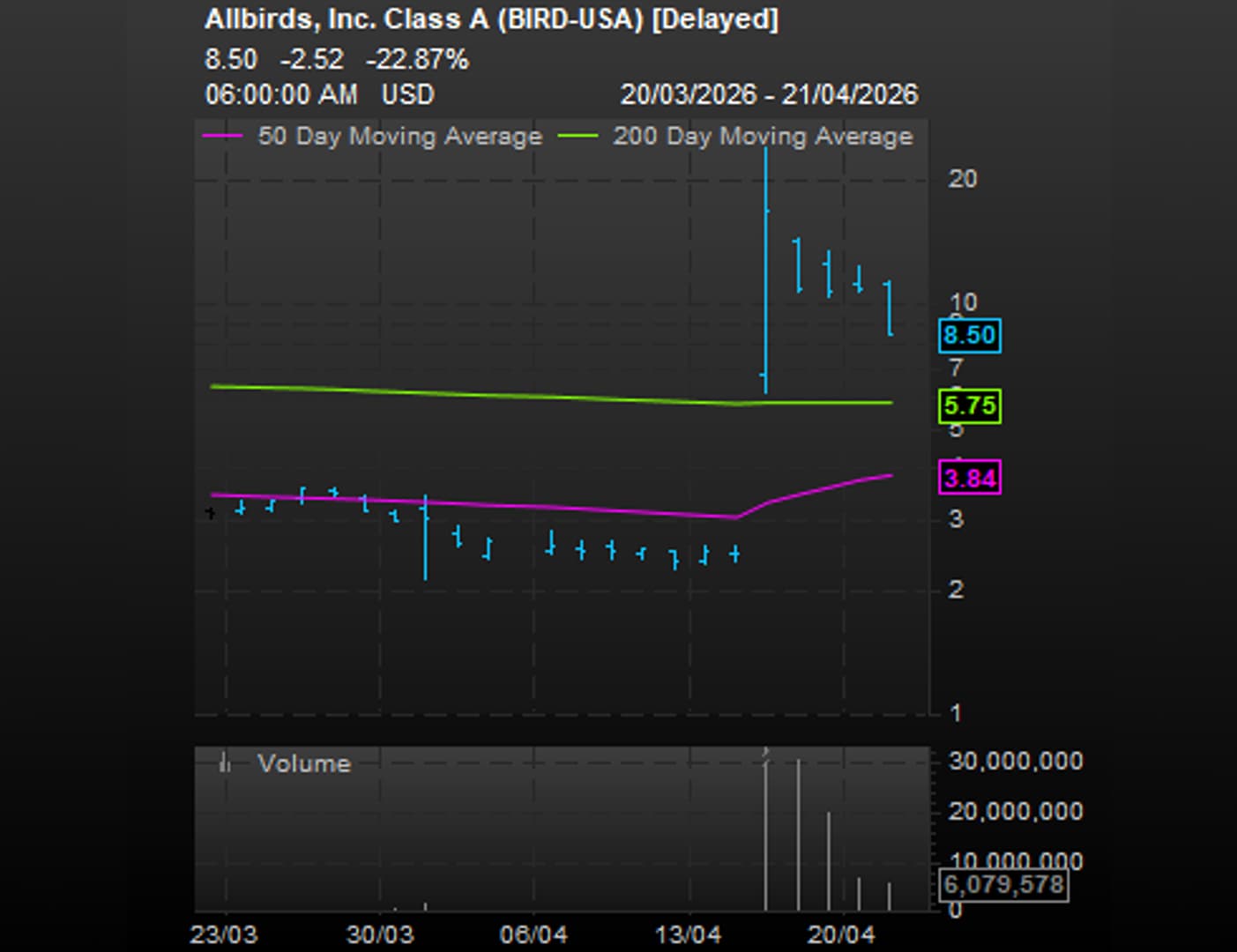
And finally, we saw the shoe company Allbirds (NASDAQ: BIRD) announce they’re ‘pivoting’, selling their brand & footwear operations to enter the AI compute infrastructure market, and changing their name to “NewBird AI”.
The market rewarded this rather unusual announcement with much gusto. The stock closed at $2.49 the day prior to the announcement, then reached a high of $24.31 the day of the announcement.
Enthusiasm has tempered a touch over the days since, now trading at $8.50, but still an interesting read on market sentiment.
All these data points serve to paint a picture of a world that’s moving rapidly, seeing huge advances, real-world applications, exploding demand with effects rippling across the economy, but all those genuinely impressive developments are coupled with at times bubble-like stock market behaviour. I think that neatly encapsulates the current moment in markets.
What was your weekly high – a standout market moment or highlight?
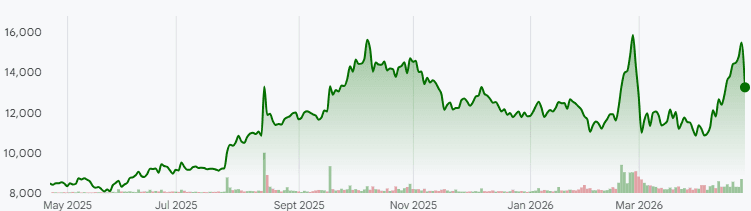
It’s been a great week or so for our holding in LG Display (KRX: 034220). This is a company that was deeply out of favour when we first bought a position in the company last year, at the time trading for a fraction of the replacement value of its underlying assets.
Since then, the market has become increasingly aware that the downturn was cyclical, not structural. Apple (NASDAQ: AAPL) is a key customer for the business, and there’s been strong sales data coming out for Apple devices around the world – particularly in China – and market share gains for the Korean suppliers of the OLED screens against their Chinese competitors in the Apple supply chain, which has all served to ignite market enthusiasm for the stock.
Despite the sharp appreciation in the share price, the market still does not even ascribe full value to their physical assets, let alone any value at all to the considerable IP and know-how embedded in the business.
What was your weekly low – a market disappointment or challenge?
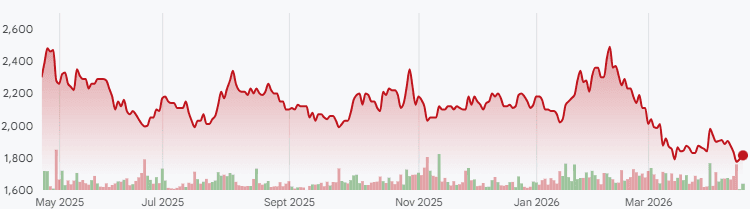
It has been disappointing to watch Mayora Indah (IDX: MYOR), a leading player in a number of Southeast Asian confectionery markets, be so heavily marked down by the market.
The underlying business has been performing well, growing, taking market share, expanding into new categories, doing everything you could ask of them really.
But the broader macro environment has been overwhelming market sentiment. Consumers across South-East Asia are under pressure with what’s been going on in the Middle East. As energy prices and fertiliser costs rise, and shortages emerge, lower income consumers in energy-import-dependent economies are likely to be the hardest hit. These consumers are the very people who buy Mayora’s products.
There’s certainly a chance the company navigates it well (think the ‘lipstick effect’), but for the moment, the market is not willing to give them the benefit of the doubt.
We’re holding on, while the current events may create turbulence over the coming months, considering Mayora’s long-term prospects, the business still has a very strong position, with a good portfolio of brands and strong distribution, now trading at what we feel is a remarkably cheap valuation.
What first drew you to markets and what continues to keep you inspired today?
I was initially actually drawn to science and engineering, out of a fascination for how the world works, with little appreciation for what a career in funds management could entail.
But I started dabbling in the stock market while at university, and found markets presented a great avenue through which I could learn about industries, products, companies, and countries. In some ways, it was just a different lens for examining & learning about the world, but it also brought a competitive and dynamic aspect to the job, which I found stimulating.
The world is endlessly interesting, and markets force you to engage deeply and rigorously with what’s going on in the world – then test you, day in day out, on your comprehension and interpretation of events, as well as your risk management skills.
That part of the job will never get old.
What’s one piece of advice you’d give to new investors?
Start by being really honest about how much risk you can afford to take, financially and emotionally.
Next, find an approach to investing that you believe in and suits your temperament, then hone your craft from there.
I genuinely believe most people are actually capable of doing it well, but it takes discipline, time and focus, which, honestly, for most, is best spent elsewhere.
That’s also why there’s an industry that exists to help do this stuff for you – so the next best option is to find a manager or professional whose approach resonates with you, where you can understand their approach to risk, and feel you are going to be able to trust in the face of inevitable market turbulence that happens from time to time.
How do you unwind when you’re not thinking about the market?
I have a young family. Spending time with them is a fantastic way to disconnect from markets and re-centre.
Aside from that, I love reading when I get the chance, and try my best to keep fit – although these days the consistency of my 30 min walking commute to and from work probably does as much for me as whatever minimal gym or other exercise I manage to squeeze in.
I was also an avid skier before having kids, so we’ve booked in a family trip to Thredbo this year, and I’ve got my fingers crossed that my four-year-old daughter loves it so we can make it a family tradition.
Rapid fire! 🔥
Favourite investing book?
For new investors, it’s hard to go past Peter Lynch’s One Up On Wall Street.
Favourite investing or finance/markets-related podcast?
Bloomberg has a great selection of finance and markets podcasts like Odd Lots and The Big Take.
The first thing you read each morning?
I have curated a series of emails I use to track the geographies and industries of interest to me, along with the news.
Favourite restaurant?
For those of you in Sydney after a casual but delicious ramen, you have to try out Nichi Getsu Do – delightful! Or if you’re after a more elevated experience, it’s hard to go past the food and vibe at Ragazzi.
Something people are surprised to learn about you?
I’ve been struggling away trying to learn Mandarin for a decade.
Learn more about Platinum’s approach to investing in Asia
Explore how the Platinum Asia Fund navigates market cycles, technological disruption and long-term structural growth opportunities.
Tags
Share this
Disclaimer
The above information is commentary only (i.e. our general thoughts). It is not intended to be, nor should it be construed as, investment advice. To the extent permitted by law, no liability is accepted for any loss or damage as a result of any reliance on this information. Before making any investment decision you need to consider (with your financial adviser) your particular investment needs, objectives and circumstances.
Related Journals
View all related reads
September 2026 Investor Update | Platinum International Fund
David Steinthal, Portfolio Manager of the Platinum International Fund, discusses the current investment environment, the ongoing impact of artificial intelligence on markets and company fundamentals, and why Platinum continues to see compelling long-term opportunities across much of the portfolio.
Platinum Asia Fund | Investor Update
Watch Cameron Robertson, Portfolio Manager of the Platinum Asia Strategy, discuss the forces shaping Asian markets, emerging growth opportunities and long-term themes for the Platinum Asia Fund. Released 1 September 2026.
When a good idea meets borrowed money
Artificial intelligence is transforming the global economy, but great technologies don't always make great investments. Understanding scarcity, valuation and leverage remains critical.